
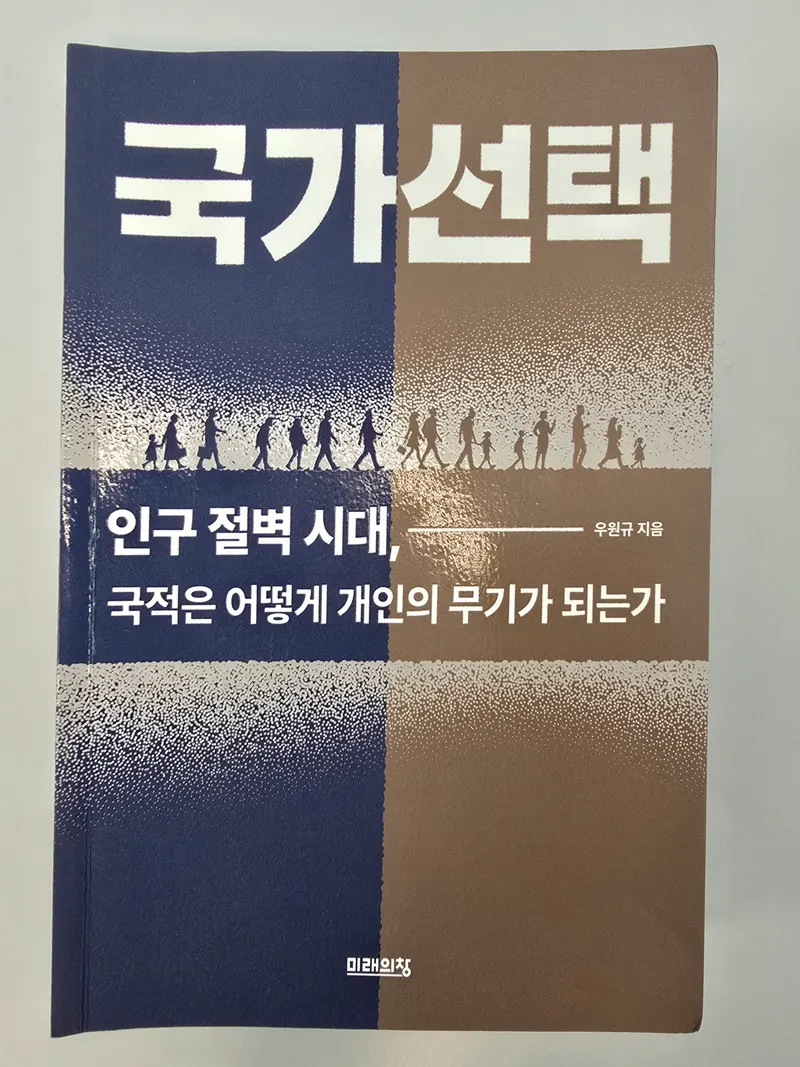
1. What Kind of Book This Is
Choosing a Country argues that in a world where low birth rates and aging are both accelerating at once, the day is coming when individuals, not just nations, get to choose. The author’s starting point is simple: a nation is ultimately made of people, and as that number shrinks, the workforce needed to run defense, public safety, welfare, and education runs short — and once it does, the engine behind the whole system called a “nation” switches off.
The book’s material roughly breaks down as follows.
① A Shift in the Relationship — The relationship between state and citizen has shifted from fate to contract. In an age of free movement, abundant information, and falling language barriers, individuals no longer belong to a nation — they evaluate it the way they’d evaluate an employer. The author writes that patriotism has become “the scarcest resource of all.”
② The Population Tipping Point — The real limit isn’t the moment the elderly share crosses 30% or 40%; it’s the moment hospitals, schools, and shops start disappearing. And the people who sense that first — and can leave first — are the young, which is exactly the vicious cycle.
③ Two Prescriptions and Their Limits — Raising the birth rate, or accepting immigration. The former runs into the clear ceiling of cash incentives; the latter comes bundled with social conflict. Germany’s guest workers, France’s second-generation problem, Britain’s Windrush scandal and Brexit, and America’s self-contradicting immigration policy all appear as case studies.
④ The Age of Selection — And yet no country has actually stopped immigration. What’s changed is the method — it’s gotten more precise. The world is converging on a single direction: shrink low-skill intake, expand high-skill intake. As of 2021, roughly 23% of Canada’s population was foreign-born, and its provinces now have systems to directly recruit the workers they need.
⑤ AI Is Not the Answer — Personally, the most striking rebuttal in the book. AI and robots can replace production, but they can’t replace consumption. A national ecosystem stands on a population that does both at once.
⑥ Korea’s Position, and an Individual’s Strategy — Japan is a managed decline, Singapore is controlled selection, Taiwan is Korea’s high-risk variant. Sitting among them, Korea carries both the risk of division and little experience absorbing immigration. What the author recommends to individuals is dual citizenship, multiple identities, and the capacity to become a “coordinator” who bridges different domains.
2. What I Confirmed on Campus
I was in California while I read this book. As an exchange student, I exist as a single line of records in a system called SEVIS. When I entered the country, which school I’m enrolled at, how many credits I’m taking this term — it all uploads to a database in real time, and my stay in the country depends on that record staying intact. When the book discussed America’s immigration management system, it wasn’t a case study to me — it was my ID.
And campus held two kinds of scenes at once.
One was Indian and other Asian students. For them, working in Silicon Valley didn’t look like a special event — it looked like the default. Finish the degree, go through practical training, join a company, and inside it, actually build products and ideas that change society. The other was students from Mexico aiming for construction management. Their direction was different. People who already had field experience were securing a degree as credentials to climb into a management track.
At first I thought these were two separate stories. After finishing the book, I understood they were the top and bottom of the same one. What the author calls “shrink low-skill, expand high-skill” doesn’t mean expelling low-skill labor — it means entry is only granted once you’ve passed through the gate of a credential. Mexican students earning a degree in construction management aren’t a shrinking of the low-skill pathway; they’re that pathway being upskilled. Selection wasn’t operating by closing the door — it was operating by reshaping it.
What I also learned, at the same time, is that the shape of that door changes every year. Steep hikes to work-visa fees, proposals to impose similar costs on post-graduation practical training, new rules rewriting how length of stay gets calculated. Even in the few months I’ve been here, the news kept updating. I learned — not from a document, but from the atmosphere — that designing your whole life around a single top-tier ticket is itself a risk.
3. Where I Started Reading Critically, and Where That Flipped
Honestly, when I opened this book I already had the ending predicted: it would land on “so leave Korea.” And I was ready to argue against that ending — I’m someone temporarily out in another country right now, and turning that experience into grounds for an exit struck me as lazy logic.
The book didn’t go there. The worst-case scenario the author warns against isn’t people leaving — it’s a “settled society” where only the people who want to leave but can’t are left behind. The problem isn’t mobility. It’s inequality in the capacity to be mobile.
So the single sentence I took away most from this book is this: there’s no need to abandon Korea, and no need to cling to it either. Make it a base camp. A base camp is neither a place you discard nor a place you settle into. You start from it and return to it, while holding the premise that the summit might be somewhere else.
I got the same impression watching people working in America. The ones doing well weren’t dependent on America. They weren’t dependent on their company either. They were moving toward positions that matched their own interests and direction, and what made that movement possible was their “professionalism.” Before I read this book, I only vaguely understood that in a market where nations choose their suppliers, what gets you chosen isn’t nationality — it’s that professionalism.
4. Numbers I Didn’t Know, and a Trick of Perception
The most embarrassing part of reading this book wasn’t immigration or population — it was retirement.
Korea’s elderly poverty rate is 39.7%. That’s 2.7 times the OECD average of 14.8%, and the highest among member states. What shocked me more was the composition of that income. Earned income accounts for 49.9% of elderly Koreans’ income, while public transfer income covers only 29.1%. Private pension transfer income is nearly nonexistent. Elderly people in Korea don’t live on pensions — they live by working.
That made me turn the question on myself. Why didn’t I know this? At first I assumed the media had covered it up. But when I actually looked at the record, that wasn’t true. The number kept falling — 49.6% in 2015, 45.7% in 2017, 43.8% in 2019, 43.4% in 2021, 40.4% in 2023 — and coverage at every point in time was accurate, and every one of those reports was framed as “improvement.” It wasn’t a cover-up — coverage of the trend replaced any sense of the actual level. Hear “it’s getting better” enough times, and you stop asking where you’re actually standing.
The exact same thing was true of the pension numbers. I’d been holding onto “13%” in my head like it was some enormous contribution burden — but that’s the premium rate phased in over eight years, reaching that level only in 2033. The metric that actually matters to the person receiving it, the income replacement rate, is 33.4%, below the OECD average of 43%. The rate you pay in, the rate you get back, and the rate the state spends are three completely different numbers, and I’d been lumping all three together as one.
As a junior, I think the practical lesson I took from this book lives right here. Not outrage — habit. Open the actual indicators yourself, and read them by separating direction from level. That’s a skill that transfers directly to how I think about my own career path.
5. Reading It Alongside Advice from IEEE
Around the time I was writing this up, I heard a professor’s advice at an IEEE Pioneer Branch meeting: expertise doesn’t come from “gold digging.” Chasing wherever money happens to be flowing can look advantageous in the moment, but it doesn’t accumulate. Only aligning with your own dream — hypnotizing yourself into it if you have to — lets you draw out a long, stable future.
Set next to the book’s logic, the two were saying the same thing. In a market where nations choose people, what ultimately gets you chosen is irreplaceability — and a résumé built by chasing trends disappears the moment the trend passes. Only someone who set their own direction can keep rebuilding their own place in it.
So I’ve redefined what this semester means to me. Not grades or a résumé, but time to physically experience how things actually run in a different society, and to meet as many people as I can. I’m learning here that instead of fitting myself to a spec, if I become someone of genuine value, only then do I actually get to decide what kind of life I want to live.
6. Closing — TSE Doesn’t Define Me
This book made the reasoning behind my interest in Technical Sales much clearer to myself. Understanding technology without staying confined inside it, bridging customers, engineering, and the supply chain, and accumulating results not in a specific codebase but in the ability to define problems and in relationships. A lot of that overlaps with what the author calls a “coordinator.”
Honestly, though, there’s a point I should be upfront about: Technical Sales is actually a role with very high dependence on language and culture. Held up literally against the author’s standard — “hold a job with low dependence on nationality” — it can look like a disadvantage. But I think the dependence is a different kind. A pure engineering role’s dependence on nationality is pinned to institutions — visas and sponsorship — which I can’t control. A coordinator’s dependence is pinned to capabilities — language and instinct — which can be accumulated and carried across borders. And the role of translating a hands-on understanding of Korea’s semiconductor and embedded ecosystem into another market’s language simply doesn’t exist without a base camp to begin with.
And finally, there’s one thing I want to be clear with myself about. TSE is part of the process by which I find my path and the world — it is not the name that defines who I am. The moment I let a title explain me, I start shaking whenever that title shakes. That’s precisely what the book warned against. Someone who pins their identity to a single affiliation sinks along with it when that affiliation weakens.
So the conclusion is neither leaving nor staying. Build the capacity to leave, without making leaving the goal. If you have that capacity, staying becomes a choice too — but without it, staying isn’t a choice at all, just an outcome. At twenty-something, I don’t think the task in front of me is picking a nationality — it’s becoming someone who could choose either one.
References
- Woo Won-gyu, Choosing a Country (국가선택), Miraebook, 2026.
- National Pension Research Institute analysis; OECD, Pensions at a Glance 2025 — elderly income poverty rate and income composition
- Statistics Korea, Future Population Projections: 2022–2072 — elderly population share projections
- Korea Institute for Health and Social Affairs, “Changes in Public and Private Pension Structures Across OECD Countries” — public pension spending as a share of GDP