
1. Was the Ladder Kicked Away, or Simply Forgotten?
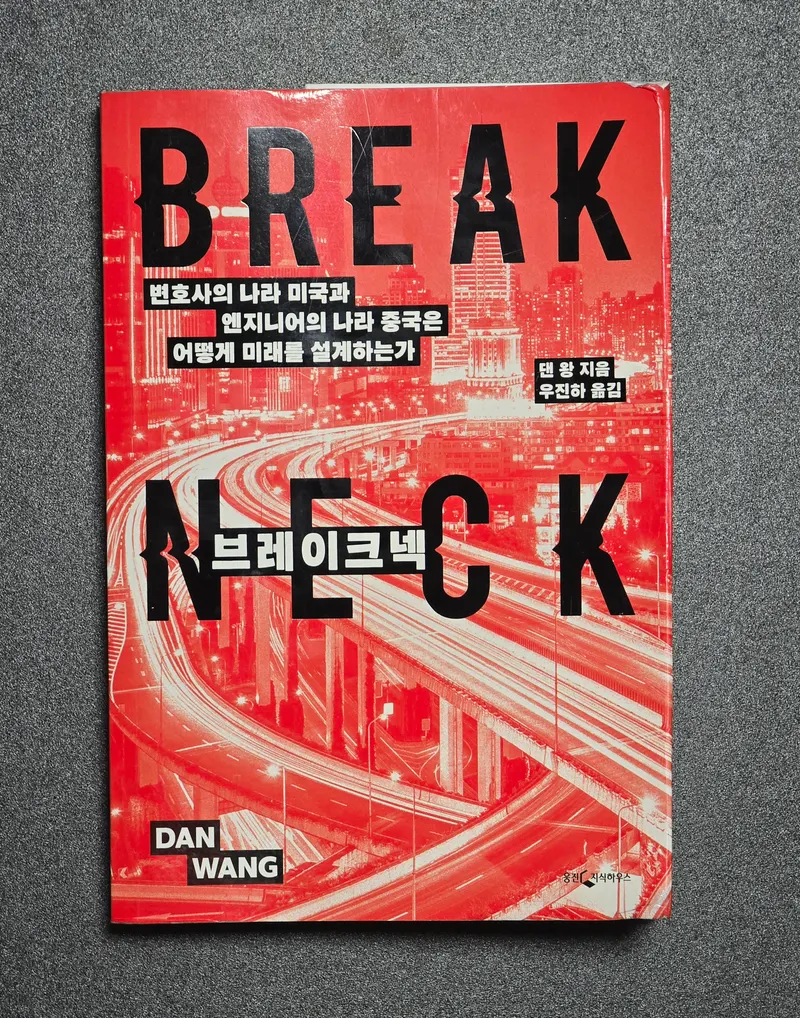
Ha-Joon Chang’s Bad Samaritans argued that rich countries grew up on protectionism and then turned around and demanded free trade from everyone climbing after them — they kicked away the ladder once they’d used it to get to the top. That metaphor has had a long run, and it’s still the first thing people reach for to explain America’s tariffs and export controls today.
But after reading Dan Wang’s Breakneck, I think the metaphor itself has been forgotten by time. The America of 2026 hasn’t kicked the ladder away — it has forgotten how to build one in the first place.
The book’s “FOGBANK” anecdote captures this difference in a single image. FOGBANK is a key material in American nuclear warheads. When the U.S. needed to remanufacture it in the 2000s, it couldn’t reproduce the process. The blueprints hadn’t vanished — the engineers who held the tacit, hands-on know-how had simply retired, and that knowledge left with them. To kick a ladder away, you first have to be holding one. The U.S. set its ladder down a long time ago.
This report borrows Dan Wang’s framework to read the AI race and tariff war unfolding right now, running current AI trends — DeepSeek V4, Kimi K3 — through the lens the book provides.
2. A Nation of Engineers, a Nation of Lawyers
Dan Wang’s thesis is simple: China is governed by engineers, and America is governed by lawyers.
The two countries approach problems with fundamentally different instincts. Take building a bridge. An engineer (China) looks at structure and stability; a lawyer (America) looks at procedural legality and due process. To an engineer, a good outcome is a bridge that stands. To a lawyer, a good outcome is a review that was conducted properly.
That’s why the Beijing–Shanghai high-speed rail was finished in three years, while California’s high-speed rail has spent nearly twenty bouncing between environmental review (EPA) and litigation. China builds roads and housing ahead of demand and waits for demand to catch up. America cuts investment, shrinks its asset base, and puts property rights and procedural legitimacy first.
This isn’t a book that praises China. In Chapter 4, the author lays out the disasters this engineering mindset has caused.
Song Jian, a scientist who calculated missile trajectories, applied the language of cybernetics to population itself. He calculated China’s “optimal” population at 700 million, projected that unchecked fertility would push the population into the billions, and the Communist Party trusted him — reasoning that someone who could precisely calculate a missile’s arc could just as precisely calculate the nation’s demographic future.
The result was forty years of catastrophe. Squads were dispatched to the countryside to force abortions; officials “creatively” enforced birth limits by demolishing homes and firing people from their jobs. Tens of millions of girls disappeared from the statistics.
Zero-COVID is the product of the same logic. In the spring of 2022, Shanghai was locked down for two months. Residents of the world’s most cosmopolitan city worried about starving, scraping by on group-buy deliveries. Treating an entire population as a single control system through facial recognition and movement tracking comes from the exact same root as the ability to build a high-speed rail line in three years.
The book’s real argument isn’t “China is right” — it’s that Tianjin’s skyline and the one-child policy are two faces of the same mindset.
3. Why AI Development Has Split in Two Directions
Let’s bring the book’s 2025 argument into the present. As of 2026, American and Chinese AI development have clearly diverged.
America trains massive models on abundant compute and focuses on turning them into agents. The Claude and GPT families don’t release their weights; they recoup revenue through API billing. It’s capital-intensive, design-focused, and margin-seeking — exactly the “low-capital, high-value” Wall Street mindset Dan Wang criticizes in Chapter 3.
China took a different path. Working under the constraint of semiconductor export controls, DeepSeek broke through on architectural efficiency. Sparse attention, MoE, long context — all of these are solutions born from the constraint of “the same performance with less compute.” When it released V4 in April 2026 and formally launched it in July, it even introduced peak/off-peak pricing that treats compute like electricity. That’s not the thinking of a software company — it’s the thinking of an infrastructure engineer.
But the thing that decisively upended this picture was Kimi K3.
Released by Moonshot AI in July 2026, K3 weighs in at 2.8 trillion parameters — the largest open-weight model released to date. It supports a 1-million-token context window and beat America’s previous-generation top models on coding and agentic benchmarks. Then, on July 27, Moonshot released the full weights under a modified MIT license. This is Chinese-style thinking crystallized.
That same mindset shows up in Chapter 2 of the book. In the early days of the pandemic, facing a shortage of masks and PPE, American companies calculated “production cost,” while Chinese companies calculated “profit being left on the table.” Large firms piled in with government subsidies, and the resulting overproduction meant almost no one made a big profit.
But China took the market.
K3’s release strategy follows the exact same formula: drive your own margin to zero to collapse the other side’s revenue model. Sure enough, competitors’ stock prices inside China dropped sharply right after K3’s release, and the API-billing logic behind American AI models is now facing a fundamental question. If a model anyone can self-host delivers top-tier performance, can a closed model keep charging a premium?
China treats AI not as a software industry but as manufacturing — it torches the market with oversupply, sacrifices margin, and eats the ecosystem. This is exactly what happened in energy and EVs.
And this is the paradox America’s export controls have produced. As Dan Wang points out in Chapter 5, when the U.S. cut off chip supply, China lowered its dependence and poured resources into developing its own. The controls didn’t stop China — they spurred it on.
4. Why Manufacturing Is Decisive in the Age of AI
In Chapter 3, Dan Wang breaks the core elements of technology into three parts: tools, explicit instructions, and procedural knowledge. Procedural knowledge is the weapon held only by technicians whose hands have absorbed a skill over decades.
Tim Cook once remarked that you could fit every tooling engineer in America into a single conference room, while China could fill several football stadiums. Foxconn’s Zhengzhou complex — more famous for building iPhones — is a city unto itself, and an intangible aggregate of exactly this “procedural knowledge.”
America can build Teslas and mRNA vaccines but can’t make masks or cotton swabs. After Boeing merged with McDonnell Douglas, it drifted toward investor-driven decision-making and became, in the author’s words, a hollowed-out manufacturer that had lost its procedural knowledge.
What about Korea?
Look at Samsung’s Exynos. It was effectively cut out of the Galaxy S25, and voices in the industry began questioning whether System LSI and the foundry business could even survive. The cost of buying chips from Qualcomm instead came back as billions of dollars in losses.
And yet Samsung sharpened its knives and came back with the Exynos 2600, built on a 2nm GAA process — improving 2nm yield from the 20% range to over 60%.
What matters here isn’t “it came back” — it’s “the cost of coming back.” Generations of criticism, losses in the trillions of won, and the workforce and process know-how that nearly slipped away in the meantime — that’s the exact lesson FOGBANK teaches. Manufacturing capability, once let go of, can’t simply be bought back with money. Reproducing it takes years, and during those years you’re at risk of being permanently overtaken.
The same problem repeats in batteries. Korea is ahead in cell manufacturing, but cathode/anode materials and refining remain deeply dependent on China, which has completed a full stack from minerals all the way to cells. Being excellent at one layer and controlling every layer are two very different kinds of leverage.
5. A Shrimp’s Strategy Between Whales
The most urgent thing is to face, clear-eyed, the path by which America’s controls on China loop back onto us. U.S. export controls accelerated China’s push for chip self-sufficiency — the growth of CXMT and YMTC is the result. Korea’s memory-chip lead has long been treated as a safe zone, but once China starts pushing volume in commodity DRAM and NAND, that lead will crack on price first. We should remember how the solar and battery markets were eaten away.
In other words, the risk we face isn’t “which side to stand on between America and China” — it’s that a competitor created by American policy is eating into our market. This isn’t a question of choosing sides; it’s a question of capability.
So I think three things are needed.
First, we need to drop the complacency around memory semiconductors. The current boom may not be a structural advantage — it may just be one wave of a cycle.
Second, we shouldn’t judge system semiconductors and foundries on profitability alone. The lesson of Exynos is that, however much criticism it draws, we can never let go of manufacturing. In manufacturing, the stop button is the reset button.
Third — and this is ultimately what the book argues — we must not slide into a rigid, black-and-white political system. Dan Wang says America needs more technocrats, and China needs channels through which dissent can be expressed. Engineers’ judgment isn’t always right. But a country of lawyers where only procedure survives and no results get made isn’t the answer either.
We need to become a flexible shrimp that can take on both American-style process and Chinese-style speed.
6. Closing Thoughts
The book’s final line has stayed with me. The author writes that he hopes America remains a “voluntary developing country” — grateful that it is not yet a finished, developed nation — and rediscovers the DNA of its earlier growth.
Korea, more than most, knows the pain of development, and I think it needs to hold onto that attitude all the more urgently.
AI can’t replace everything. What trains a model is a GPU; what makes a GPU is a factory; what runs a factory is knowledge held in hands, knowledge that never makes it into a document. The more we move into the AI era, the more decisive it becomes how many people, and where, actually know how to make things.
I’ll close with the line that stayed with me the most:
The number of engineers per capita matters more than the Communist Party’s policies or Washington’s tariffs. — Dan Wang